Counting leading zeros in Solidity using CLZ opcode
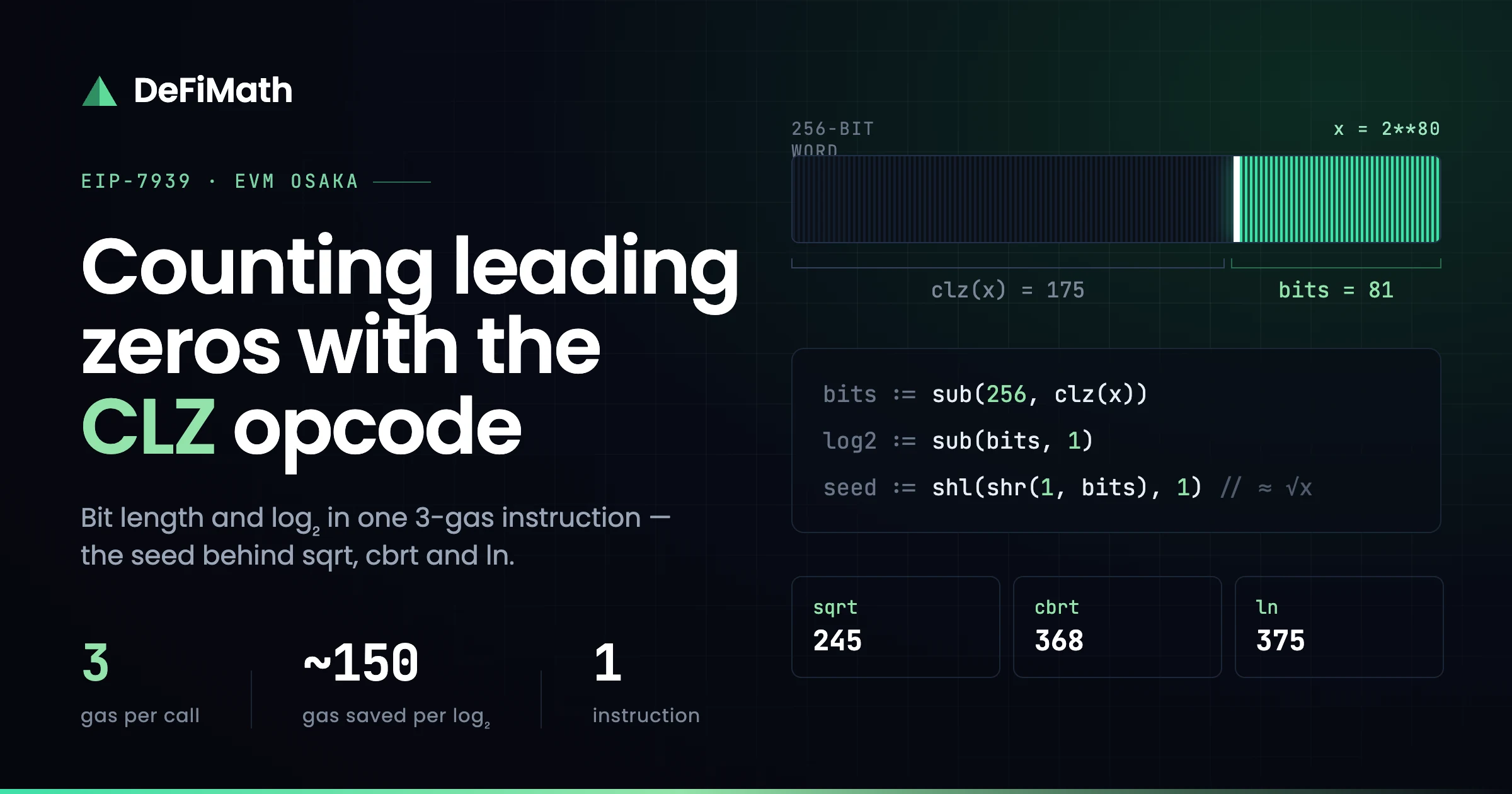
The CLZ opcode landed in EVM Osaka via EIP-7939, exposed in Solidity 0.8.31 as the Yul builtin clz. It costs 3 gas, returns the number of leading zero bits in a 256-bit value, and replaces the loops and lookup tables every previous on-chain library used to compute the same thing. DeFiMath sits on top of it. This post walks through what CLZ actually does, the one-line idiom it enables, and the three places in the library where it's the hot path.
What CLZ does
The opcode pops one value off the stack and pushes a single number: how many of that value's 256 bits are zero before its first set bit. A few examples:
clz(0)                 = 256
clz(1)                 = 255
clz(2 ** 80)           = 175
clz(type(uint256).max) = 0
Two things to note. First, clz(0) = 256 — the convention chosen by the EIP. You don't have to special-case zero before calling it, only after. Second, the result is exactly 255 − floor(log₂(x)) for nonzero x. That equivalence is the entire point: bit length and base-2 logarithm are the same primitive, and now we can read them in 3 gas.
How to use it in Solidity
Solidity 0.8.31 exposes clz as a Yul builtin:
function bitLength(uint256 x) internal pure returns (uint256 bits) {
    assembly { bits := sub(256, clz(x)) }
}
The opcode requires the Osaka EVM target — add this to your hardhat.config.js:
solidity: {
    version: "0.8.31",   // or newer
    settings: { evmVersion: "osaka" }
}
Targeting an older EVM and calling clz is a compile-time error, not a runtime surprise. Bad config fails fast.
The bit-length trick
Every CLZ-based optimization in DeFiMath grows from one identity:
bits = 256 − clz(x)             // bit length of x
floor(log₂(x)) = bits − 1       // for x ≥ 1
bits lets you do two useful things almost for free:
- Find the largest power of two ≤ x —
2^(bits − 1). Useful for range reduction. - Find a power of two near the k-th root of x —
2^⌈bits/k⌉. Useful as a Newton-Raphson initial guess.
Both compile to one instruction. The rest of the post is what we do with that.
Use #1: sqrt initial guess
Newton-Raphson for square root iterates y ← (y + x/y) / 2 and roughly doubles the number of correct bits per step. The catch is that you have to start somewhere. A constant initial guess (say, y₀ = 1) needs ~30 iterations to converge to 18 decimals — a non-starter on-chain.
CLZ collapses the initial-guess problem: y₀ = 2^⌈bits/2⌉ is within a factor of √2 (~1.41) of the true root. From one bit of error, six Newton iterations land bit-exact at the 1e18 fixed-point scale. The DeFiMath sqrt hot path:
assembly {
    x := mul(x, 1e18) // scale to 1e36

    // y₀ ≈ 2^⌈bits/2⌉, within factor √2 of sqrt(x)
    y := shl(shr(1, sub(256, clz(x))), 1)

    y := shr(1, add(y, div(x, y)))  // Newton, ×6
    y := shr(1, add(y, div(x, y)))
    y := shr(1, add(y, div(x, y)))
    y := shr(1, add(y, div(x, y)))
    y := shr(1, add(y, div(x, y)))
    y := shr(1, add(y, div(x, y)))
}
That's the whole function. 245 gas average.
Use #2: cbrt initial guess
Same trick at a different exponent. For cube root, y₀ = 2^⌈bits/3⌉ lands within a factor of ∛2 (~1.26) of the true cube root. Six iterations of the cube-root Newton update y ← (2y + x/y²) / 3 get to bit-exact precision. The cbrt page has the full breakdown — most notably why this lets cbrt be single-branch where sqrt needs an inversion branch for x < 1. 368 gas average.
Use #3: ln range reduction
The Mercator series for ln converges slowly when x is far from 1. The classic remedy is to reduce x into [1, 2): find the integer k = floor(log₂(x)), then x / 2^k lives in [1, 2). The final result is ln(reduced) + k · ln(2).
Pre-Osaka, computing k required a binary-search-by-shift or a de Bruijn lookup — ~150 gas, dozens of opcodes, the kind of careful thing Solady's log2 does. With CLZ it's two instructions:
assembly {
    let bits := sub(256, clz(integerPart))  // floor(log₂(integerPart)) + 1
    x := shr(bits, x)                       // reduces x to [1, 2)
}
DeFiMath's ln does exactly this, then narrows further to [1, √2) with one more conditional divide so the Mercator series converges in ~10 terms. Total: 375 gas.
What this looks like across the libraries
| Function | DeFiMath | PRBMath | ABDK | Solady |
|---|---|---|---|---|
| sqrt | 245 | 959 | 808 | 341 |
| cbrt | 368 | — | — | 550 |
| ln | 375 | 6,901 | 12,695 | 518 |
Solady is the closest competitor and the only one within 2× on sqrt — they bridge the initial-guess gap with a hand-tuned binary search. The widening gap on cbrt and ln is mostly the savings CLZ gives at the front of each function. PRBMath and ABDK predate the opcode entirely; they pay for log₂ in software at every call.
The two functions where Solady stays competitive are exactly the ones with the cheapest pre-CLZ workarounds. The ones where DeFiMath pulls ahead are the ones that need both a fast initial guess and a fast range reduction — and CLZ delivers both for the price of two opcodes.
Compounding effects
The savings don't stop at the primitives. sqrt and ln are the building blocks of Black-Scholes option pricing: both callOptionPrice and putOptionPrice call ln(spot / strike) once and a sqrt-based time-adjusted volatility once per evaluation. Swapping in the CLZ-powered versions of those two primitives drops callOptionPrice from ~3,100 gas to 2,876 gas — roughly 10% cheaper, with zero change to the option-pricing math itself.
The pattern repeats across the library. Every function that touches a root or a logarithm — IV solving, futures, log returns, historical volatility, Sharpe ratio — gets a free discount the moment its inner primitives switch to CLZ-based versions. The opcode doesn't just save ~150 gas on one log2 call; it saves that ~150 gas everywhere log2 lives.
Caveats
- Osaka EVM target required. CLZ is only available on Osaka and later. Targeting Cancun, Shanghai, or earlier won't compile if your code references
clz. - Solidity 0.8.31+. Earlier versions don't expose the Yul builtin. (You can still emit the opcode by hand with
verbatim, but at that point you're writing assembly assembly.) clz(0) = 256. Don't try to guard against zero before the call — the opcode handles it. Guard after, if your algorithm assumes a nonzero input.
Try it
npm install defimath-libCLZ-powered primitives: sqrt, cbrt, ln. The library is MIT-licensed, pure Solidity, zero runtime dependencies. Source on GitHub, reference benchmarks against PRBMath, ABDK, Solady and SolStat in defimath-compare.
The CLZ opcode itself is specified in EIP-7939.